
VERSIÓN EN ESPAÑOL
Physical inactivity has been identified as a leading risk factor for global mortality and a contributor to the rise in overweight and obesity. Early childhood is a period of rapid physical and cognitive development and a time during which a child’s habits are formed and family lifestyle habits are open to changes and adaptations.
To meet daily physical activity time recommendations, particularly in children, the pattern of overall activity across a 24-hour period needs to be considered, since the day is made up of sleep time, sedentary time and light, moderate- or vigorous-intensity physical activity.
The primary audiences for these guidelines are policy makers in ministries of health, education and /or social welfare, working in high- as well as low- and middleincome countries, persons working in non-governmental organizations and early childhood development services, and those providing advice and guidance to caregivers, such as community or family nurses or doctors, paediatricians or occupational therapists.
These guidelines are intended to assist officials as they develop national plans to increase physical activity, reduce sedentary time and improve time spent sleeping in young children though guidance documents and define critical elements of childcare services and pre-service training for health care and early childhood development professionals.
The overall goals of these guidelines are to provide recommendations on the amount of time in a 24-hour day that young children, under 5 years of age, should spend being physically active or sleeping for their health and wellbeing, and the maximum recommended time these children should spend on screen-based sedentary activities or time restrained. By providing this guidance, the recommendations fill a gap in the WHO recommendations on physical activity, as children under 5 years of age were not included in the Global recommendations on physical activity for health in 2010 and will also contribute to the implementation of the recommendations of the Commission on Ending Childhood Obesity and the Global Action Plan on Physical Activity 2018–2030. These guidelines also contribute to the broader Nurturing care for early childhood development framework. Nurturing care encompasses health, nutrition and safety needs, as well as early learning opportunities. These guidelines do not specifically address the physical activity, sedentary and sleep needs of children with disabilities or chronic disease. The recommendations may be appropriate for children with disabilities or chronic disease, but parents and caregivers should seek additional advice from health professionals, or those involved in providing early intervention services for a child.
The development of these guidelines was in keeping with the WHO Handbook on development of guidelines and commenced in 2017 with the formation of a Steering Group. The Guideline Development Group (GDG), composed of technical experts and relevant stakeholders from all six WHO regions, met in November 2017 to decide on the critical questions and outcomes to be assessed. Existing, recent, high-quality systematic reviews were updated, and the search criteria expanded to include all six official languages during 2017–2018.
GRADE profiles were prepared using methodology recommended by the Guidelines Review Committee, with the support of a GRADE methodologist. The GDG met in Ottawa, Canada in April 2018 to review the summaries of evidence for the critical outcomes, the quality of the evidence, risk and benefits of implementing the recommendations, values, preferences, feasibility, acceptability, equity and resource implications. Where there was no evidence available to inform these aspects, the GDG expertise informed the discussions. The recommendations were developed with full consensus of the group. The recommendations are summarized below, and GRADE tables are available in Web Annex Evidence Profiles . The recommendations will be updated within ten years, unless further research in the area provides additional evidence to warrant an earlier update. Practical tools to support issemination,
adaptation and implementation of the recommendations will be developed.





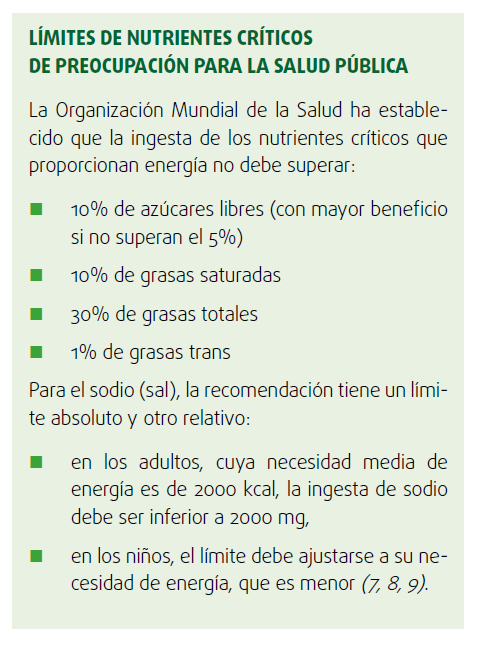 La mala alimentación guarda una estrecha relación con estos tres factores principales de riesgo en la Región, debido en gran parte a la ingesta excesiva de azúcares, grasas totales, grasas saturadas, grasas trans y sodio, los denominados “nutrientes críticos” de preocupación para la salud pública (véase el recuadro) (7, 8, 9). La ingesta excesiva de estos nutrientes es resultado, en gran medida, de la amplia disponibilidad, asequibilidad y promoción de productos alimentarios procesados y ultraprocesados, que contienen cantidades excesivas de azúcares, grasas y sodio (10, 11). Por consiguiente, gran parte de la solución consiste en la aplicación de leyes y regulaciones que reduzcan la demanda y la oferta de productos que contienen cantidades excesivas de nutrientes críticos. Uno de los instrumentos clave de política para regular esos productos con el objeto de prevenir el desequilibrio en la alimentación es la utilización de etiquetas en el frente del envase que indiquen a los consumidores que el producto contiene cantidades excesivas de azúcares, grasas totales, grasas saturadas, grasas trans y sodio.